Showing posts with label Artifact of the Month. Show all posts

Friday, July 26, 2013

Artifact of the Month: CERA Medallion


By Richard I. Gibson

保皇會

The Digging Butte’s Chinatown exhibit has been on display for three years – but it turns out we didn’t have all the cool stuff out there.

Thanks to a visit from Mark Johnson, a Montana native who teaches at the Concordia International School in Shanghai, we found an important artifact. Mark is studying the Chinese Empire Reform Associations (CERA; Chinese Baohuanghui, 保皇會, or “Protect the Emperor Society”) in Montana, and was interested in a Montana Standard photo of archaeologist Mitzi Rossillon holding a CERA medallion found during the dig in 2007. It came from “Feature 6,” the site demolition deposit that includes materials from the 1890s to the 1940s. Because there was no good stratigraphy, Mitzi elected not to catalogue that material.

We found the medallion in the unsorted collection this month.

The CERA began in Victoria, British Columbia, in 1899, created by exile Kang Youwei. CERAs supported the short-lived reforms instituted by the Guangxu Emperor (reigned 1875-1908) to modernize (and to some extent, Westernize) China; his plans were thwarted by the Empress Dowager Cixi, who placed Guangxu under house arrest and he served most of his reign after 1898 as an ineffective figurehead.
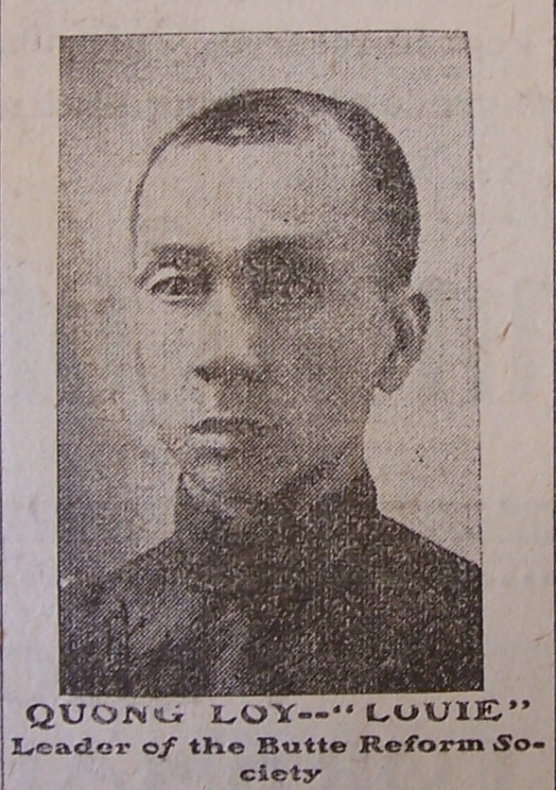
More than 150 CERAs were established worldwide, including at least nine in Montana. The Butte chapter was organized in August 1901, with Quong Loy the president. They met in various locations, including the Chinese Freemason hall (20 West Galena), 103 China Alley, and 212½ S. Colorado, which stood in today’s vacant lot across from the Mai Wah, the site of the 2007 archaeological dig that uncovered the medallion.

By 1905, the organization was actively supporting a developing army in the U.S., intended to help restore the Guangxu Emperor to power. In Butte, “the young men of Chinatown,” numbering about 30, spent many summer evenings in 1905 drilling and practicing army maneuvers “upon a roof back from the street on Mercury just west of Main street” (Anaconda Standard, January 8, 1906). But by the following year, with financial and other troubles, the military schools were disbanded by order of leader Kang Youwei. The organization effectively ended with the start of the Republic of China, in 1912, although its successor, the Chinese Democratic Constitutionalist Party (1911-1945) and other incarnations continued to have political influence for many more years.


The medallion shows an image of the Guangxu Emperor, and crossed flags of the CERA and the dragon flag of the Qing Dynasty (1644-1912; the Guangxu Emperor was second-to-last emperor of China).

Mark Johnson is working on a report on the Montana CERAs to be published in the Montana Historical Society’s Montana: The Magazine of Western History. We look forward to seeing it!

Resources: Baohuanghui blog. Quong Loy photo from Butte Miner, Feb. 7, 1902 (see also Anaconda Standard, Aug. 22, 1901); flags from Wikipedia (Creative Commons licenses). Medallion photo by Richard Gibson.

Thursday, April 25, 2013

Artifact of the Month: Kwan Gong

By Richard I. Gibson

關羽

Kwan Gong, Guan Sheng, Guan Yu, Guan Gong, Guan Di, Kwan Dai, Kwan Tai, Kuan Ti, Kuan Kung, Wu Ti, Mo Dai, Guan Di, Kuan Yu, Kwan Yu, Quan Yu, Yunchang – however you name him, the red-faced character with a black beard has a long connection with Chinese heritage. The carved wooden statue of him in the Mai Wah Mercantile Collection, part of the loan from the Montana Heritage Commission, was a centerpiece of Chinese culture in Butte for many years.

He was a real historical figure, a general in the civil war that led to the collapse of the Han Dynasty in 220 A.D. He supported his friend the warlord Liu Bei who ruled Shu Han state (around modern Chengdu) during the Three Kingdoms period (220-280). Guan himself died in 219, executed following his capture in the aftermath of the Battle of Fancheng.

His family name was Guan (or Kwan, or Kuan) and the second word is typically a title. Guan Gong means Lord Guan, while other titles include “saintly emperor,” “lord of the magnificent beard,” and “general who rocks the bandits.” Much of his life was romanticized in the 14th-century novel, Romance of the Three Kingdoms, by Luo Guanzhong.

Guan in a 1430 scroll painting
in the Beijing Palace Museum.
Public domain via Wikipedia.
Guan Yu was deified as early as the Sui Dynasty (581–618), and is still popularly worshipped today among the Chinese people. Although sometimes called a god of war, he is worshipped as an indigenous Chinese deity, a bodhisattva and heavenly protector in Buddhist tradition, and as a guardian deity in Taoism and other religious bodies. He is also held in high esteem in Confucianism. His apotheosis grew over centuries. By 1614 the “saintly emperor” title was applied, although he had never been an emperor.

Police stations in Hong Kong today typically contain shrines to Guan, and for many émigrés to America from the Guangdong (Canton) region in the late 19th century, he was the most important community and household deity. The statue in the Mai Wah collection arrived in Butte circa 1905, and resided in the community Joss House that stood on Galena Street north of the intersection with China Alley, at least until the 1920s and perhaps longer. The photo at right, a Smithers photo inside the Joss House and showing the statue of Guan that is now at the Mai Wah Museum, dates to about 1920 and was published in the Montana Standard in 1954. As Butte’s Chinatown declined, many buildings were razed, and the statue of Guan came to the Chinn family, the most prosperous and prominent family in the neighborhood in the late 1920s and onward, to be used as a household deity within the Mai Wah and Wah Chong Tai buildings where the family lived.

Guan has appeared in or been referred to in modern films, both Chinese and Western (including the 1994 comedy, From Beijing with Love), and TV shows, video games, and card games.

Based on online information, including Wikipedia article on Guan Yu.

Tuesday, April 9, 2013

Artifact of the Month: Quong On Laundry


By Richard I. Gibson

A simple sign connects us to a lot of history.

Quong On started his laundry at 44 West Galena Street about 1898, two years after attempted boycotts succeeded in driving some Chinese businesses out of Butte although the Chinese ultimately won the law suit they brought against boycott organizers.

On occupied a pre-existing laundry that was built about 1891 on the southwest corner of Galena and Colorado Streets (the former Gold Rush Casino and Restaurant fills this space today). In 1890, a laundry, possibly operated by the same predecessor to Quong On, stood in the middle of Colorado Street just south of the intersection with Galena. Streets in this part of town were not fully laid out in the modern grid system, though that happened quickly in the early 1890s.

Quong On continued on that corner until about 1925, when he moved down the block to a pre-1888 house at 122 West Galena. The location today would be the vacant lot west across Dakota Street from the Post Office. The Chinese “hand laundry” was still there in 1957, but out of business by about 1960. The Quong On Laundry was among the last Chinese laundries to operate in Butte. Two on South Arizona Street survived into the 1960s, and the contents of one, Quong Fong, are now on display at the World Museum of Mining.

In March 1904, Quong On (spelled Quon On in the Anaconda Standard for March 20, 1904), together with Quon Fat made headlines: “TWO CHINAMEN WIN OUT—will be permitted to remain in this country.” They were to be deported under the Geary Exclusionary Act, but Quon made the case (with the help of his lawyer, Edwin S. Booth of 600 E. Park) that he was in fact born in San Francisco 19 years earlier and was not subject to the Geary Act of 1892. He said he was orphaned by age 3 and survived with the help of a cousin, who paid his passage to Butte. Both Quon On and Quon Fat were exonerated by Judge Hiram Knowles (U.S. Circuit Court Judge from Missoula), who allowed them to stay in Butte—in On’s case, for nearly 50 more years.

This was one of Judge Knowles' last cases, as he retired from the bench on April 15, 1904, after a 44-year career that included a term on the Supreme Court of the Territory of Montana. 

Resources: City Directories; Sanborn Maps; Anaconda Standard March 20, 1904; Hiram Knowles Wikipedia article. Sign in Mai Wah Collection, photo by Dick Gibson. Image of Booth from Cartoons and Caricatures of Men in Montana, by E.A. Thompson, 1907 (scan by Butte-Silver Bow Public Library).

Sunday, March 3, 2013

Artifact of the Month: Shark Fins

By Mai Wah Curator Janna Norby

The shark fins in the Wah Chong Tai Mercantile are from the closing of the store in the early 1940s when Charlie Bovey bought the contents and took everything to Nevada City.

The benefits of shark fin, documented by old Chinese medical books, include the following:


Wah Chong Tai Mercantile collection (c. 1940)
  • rejuvenation
  • appetite enhancement
  • nourishing to blood
  • beneficial to vital energy
  • strength to kidneys, lungs, and bones

Shark fin treatments generally come in tablet or powder form for medicinal use. In Chinese shops such as the Wah Chong Tai, you could buy whole dried shark fin.

Though few medical studies have been completed and little or no proof has been provided, shark fin has been touted as a cancer treatment, a sexual potency booster, skin quality enhancer, heart disease prevention, and a means of lowering cholesterol and providing balance to qi, energy.

魚翅      Shark Fin Soup 

 Shark fin soup has been a popular Chinese delicacy since the Ming Dynasty (1368-1644), when it was considered to be a luxury item for the elite. Today, animal rights organizations and others oppose the inhumane treatment of sharks in harvesting, and some nations, states, and cities ban the use of shark fins for soup or other purposes.

Research and text by Janna Norby. Photo by Dick Gibson. The Wah Chong Tai Mercantile exhibit is made possible by a loan from the Montana Heritage Commission, and significant financial support from the Confucius Institute of the University of Montana.