Showing posts with label Butte Chinese. Show all posts

Tuesday, September 3, 2013

New Acquisition: Chopine Shoes


By Richard I. Gibson

High platform shoes called chopines were popular in Europe in the 16th and 17th centuries. They were intended to increase women’s stature, like high heels, and to protect rich ladies from the mud of the streets. They were probably introduced from China to Europe via Venice in the late 1400s.

showing the platforms
The Manchu people who ruled China from 1644 to 1912 apparently developed shoes like these as an alternative to painful foot-binding. The idea was that the women with bound feet, or with shoes like these, were so special, so powerful, that they did not need to walk, or at least should be protected from the dirt of the street. One legend holds that a chieftain’s daughter, Duoluo Ganzhu, who was involved in a futile battle, had the idea of using stilts or tall shoes to attack an enemy across a marshy bog—and then encouraged women to wear stylized elevated shoes in memory of the ensuing victory.

detail of sole
The shoes shown here, donated to the Mai Wah Musuem by Tina Huie in 2013, date to the 1890s. They were used in Butte by Tina Huie’s grandmother, Lily Chew Huie. Lily was born in San Francisco about 1890, and lived in Butte with her husband Sam Huie. Sam managed a restaurant at 251 East Park Street in 1927-28, and the family lived at 341 East Park and at 639 Utah. The family continued to live in Butte into the 1940s.

We believe that Sam was an older nephew of Dr. Huie Pock of Butte; Dr.Pock died in 1927, the same year Sam is first listed in the city directory. Despite this late listing, Sam and his family were in Butte at least as early as 1907. Sam and Lily had 13 children, at least 11 born in Butte, and at least two of whom (Arthur and Katie) worked in the restaurant as waiter and waitress in 1927-28, alongside Quong Huie, Huie Pock’s son. Arthur, Katie, and Quong were all listed as residing at 639 Utah Street, which was Dr. Pock’s home and office until he died. 

Sam Huie's restaurant, 251 East Park Street
(center of one-story building at left)
As did the sons of the Chinn family who lived in the Mai Wah buildings, at least six of the Huie family sons enlisted in the U.S. Army at the start of World War II, and others were involved in stateside industries and organizations involved in the war effort.

The finely embroidered shoes have a decorated wooden sole with inlaid colored fabric and braided twine.

MW 2013.08.001

Resources: City Directories, census records, information from Tina Huie; background on chopines from various online sources. Photo of Sam Huie’s restaurant at 251 East Park from Butte-Silver Bow Public Archives, building inventory c. 1950s. Modern photos by Richard I. Gibson.

Sunday, August 18, 2013

The Butte Chinese: Dr. Wah Jean Lamb


By Richard I. Gibson

Dr. Lamb was a prominent Chinese physician in Butte from about 1902-1929, probably second only to Huie Pock in the Chinese medical community here. Advertisements like the one above appeared almost daily in the Butte Miner and the Anaconda Standard in the 1910s.

Dr. Lamb was the first Chinese to receive a medical degree from the University of Southern California, one of ten graduates awarded degrees in June 1896. He had been selected by missionaries in China to come to the U.S. for his education. This began a five-generation connection to USC, as several of Dr. Lamb’s children, including Paul, Faith, and John, attended the school as pre-med students, as did later generations.

Wah Jean Lamb was born about 1870, and immigrated to the U.S. in 1885. Following his graduation from USC, he came to Butte about 1902. He left Butte with his family about 1929, and lived in San Diego at the time of the 1930 census; in 1940 he was living in Los Angeles, where he died in 1942.

Dr. Lamb’s first office was at 9 West Galena Street beginning in 1902-03; he also lived there. By the late 1910s, around 1917, much of this part of Chinatown had been demolished and he moved his office for a few years (1917-18 and perhaps later) to 116 East Mercury, near the corner with Arizona Street. Also beginning in 1917, he and his family lived in a nice home outside of Chinatown, at 1107 South Wyoming, which still stands in 2013.

By 1923, Dr. Lamb’s office was located at 46 East Galena Street, where he continued until he left Butte in 1929. This location was probably within the Copper Block (also known as the Empire Hotel), west of the intersection of Galena and Wyoming. The Copper Block hotel was known as a brothel and residence for ladies of the evening, but the ground floor held a restaurant, saloon, and at least seven storefronts, one of which was Dr. Lamb’s office in the 1920s. The Copper Block was demolished in 1990-91.

The Mai Wah has a new display of photos of Dr. Lamb’s family in Butte, donated by his grandson James Chung. (See also page 67-69 of Lost Butte, Montana)

Resources: City Directories; Sanborn Maps; USC Trojan Family Magazine Winter 1998.

Friday, July 26, 2013

Artifact of the Month: CERA Medallion


By Richard I. Gibson

保皇會

The Digging Butte’s Chinatown exhibit has been on display for three years – but it turns out we didn’t have all the cool stuff out there.

Thanks to a visit from Mark Johnson, a Montana native who teaches at the Concordia International School in Shanghai, we found an important artifact. Mark is studying the Chinese Empire Reform Associations (CERA; Chinese Baohuanghui, 保皇會, or “Protect the Emperor Society”) in Montana, and was interested in a Montana Standard photo of archaeologist Mitzi Rossillon holding a CERA medallion found during the dig in 2007. It came from “Feature 6,” the site demolition deposit that includes materials from the 1890s to the 1940s. Because there was no good stratigraphy, Mitzi elected not to catalogue that material.

We found the medallion in the unsorted collection this month.

The CERA began in Victoria, British Columbia, in 1899, created by exile Kang Youwei. CERAs supported the short-lived reforms instituted by the Guangxu Emperor (reigned 1875-1908) to modernize (and to some extent, Westernize) China; his plans were thwarted by the Empress Dowager Cixi, who placed Guangxu under house arrest and he served most of his reign after 1898 as an ineffective figurehead.

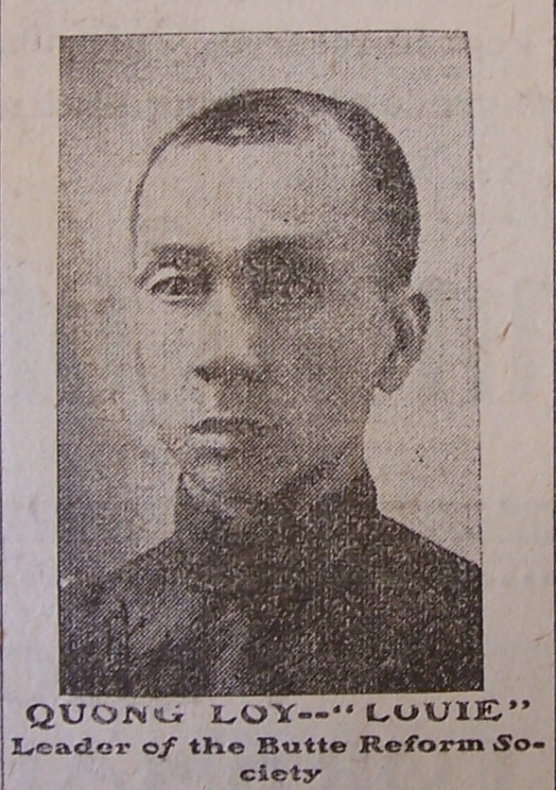
More than 150 CERAs were established worldwide, including at least nine in Montana. The Butte chapter was organized in August 1901, with Quong Loy the president. They met in various locations, including the Chinese Freemason hall (20 West Galena), 103 China Alley, and 212½ S. Colorado, which stood in today’s vacant lot across from the Mai Wah, the site of the 2007 archaeological dig that uncovered the medallion.

By 1905, the organization was actively supporting a developing army in the U.S., intended to help restore the Guangxu Emperor to power. In Butte, “the young men of Chinatown,” numbering about 30, spent many summer evenings in 1905 drilling and practicing army maneuvers “upon a roof back from the street on Mercury just west of Main street” (Anaconda Standard, January 8, 1906). But by the following year, with financial and other troubles, the military schools were disbanded by order of leader Kang Youwei. The organization effectively ended with the start of the Republic of China, in 1912, although its successor, the Chinese Democratic Constitutionalist Party (1911-1945) and other incarnations continued to have political influence for many more years.


The medallion shows an image of the Guangxu Emperor, and crossed flags of the CERA and the dragon flag of the Qing Dynasty (1644-1912; the Guangxu Emperor was second-to-last emperor of China).

Mark Johnson is working on a report on the Montana CERAs to be published in the Montana Historical Society’s Montana: The Magazine of Western History. We look forward to seeing it!

Resources: Baohuanghui blog. Quong Loy photo from Butte Miner, Feb. 7, 1902 (see also Anaconda Standard, Aug. 22, 1901); flags from Wikipedia (Creative Commons licenses). Medallion photo by Richard Gibson.